- Home
- About Us
- Participate
- Calendar
- Gallery
- Contacts
- Buddhist Studies
- Thai Language Classes
- Links & References

2023 Thai Language & Culture Graduation
Photo Gallery
Thai Language & Culture
Wai Khru Ceremony
Photo Gallery
2022 Thai Language & Culture Graduation
Photo Gallery
Loy Krathong - Thai Father's Day
Photo Gallery
Sart Thai - Khao Pradap Din
Photo Gallery
Visakha Bucha
Photo Gallery
Songkran Festival
Photo Gallery
Makha Bucha
Photo Gallery
Learning Opportunities at the Wat
Monks are Teachers
Let your visits to the temple become opportunities to learn from the monks. Over 2,600 years ago, when the Buddha first shared his realization and understanding of the Four Noble Truths with the five ascetics he had once practiced with, the seed was planted that would today yield a reference we can model our own behavior upon. Even in those days, a householder or Brahmin might notice the demeanor of one of the Noble Sangha as they went about their effort. Realizing that they were different from the other ascetics of the day, they would inquire and often receive a meaningful discussion on the Dhamma. Many times they were ultimately brought into the teachings and made great personal strides in their own realization. Even today we can look upon the Sangha and, seeing their focus, their mastery, their commitment, we can learn much.
Meditation Practice
An essential element in the path to enlightenment is careful, guided, consceintious meditation, leading to inner calm, release from stress, and a fuller and more complete understanding of the Dhamma.
At Wat Sacramento, we are currently evaluating the possibility of conducting Meditation classes on Sundays. If you are interested in participating, please contact the president of the lay person committee.
In the mean time, it is a good idea to at least begin to meditate. There is much written on the subject; some good, some not so good, and maybe even some bad. A recommended resource on the web is this collection of forty Dhamma talks by Thanissaro Bhikkhu (Ajahn Geoff) and his Meditator's Tools Study Guide.
Breath Meditation
The Steps of Breath Meditation — Forty Dhamma Talks
Begin with this linked article from the middle then go to the top of the page and read them all!
A Meditator's Tools
A Meditators Tools – A Study Guide on the Ten Recollections by Thanissaro Bhikkhu
Ajahn Geoff has also compiled a study guide on the Ten Recollections. Worth careful reading, then revisiting as your meditation progresses, and able to inspire to greater effort and diligence.
Many themes here will become familiar over time but they always add more strength to the foundation you will build and develop upon in your meditation.
Hopefully, these articles will guide and motivate more to commit to this important, critical aspect of the practice. A broader collection of online links to meditation will sprout here soon.
The Healing Power of the Precepts
Thanissaro Bhikkhu
The Buddha was like a doctor, treating the spiritual ills of the human race. The path of practice he taught was like a course of therapy for suffering hearts and minds. This way of understanding the Buddha and his teachings dates back to the earliest texts, and yet is also very current. Buddhist meditation practice is often advertised as a form of healing, and quite a few psychotherapists now recommend that their patients try meditation as part of their treatment.
After several years of teaching and practicing meditation as therapy, however, many of us have found that meditation on its own is not enough. In my own experience, I have found that Western meditators tend to be afflicted more with a certain grimness and lack of self-esteem than any Asians I have ever taught. Their psyches are so wounded by modern civilization that they lack the resilience and persistence needed before concentration and insight practices can be genuinely therapeutic. Other teachers have noted this problem as well and, as a result, many of them have decided that the Buddhist path is insufficient for our particular needs. To make up for this insufficiency they have experimented with ways of supplementing meditation practice, combining it with such things as myth, poetry, psychotherapy, social activism, sweat lodges, mourning rituals, and even drumming. The problem, though, may not be that there is anything lacking in the Buddhist path, but that we simply haven't been following the Buddha's full course of therapy.
The Buddha's path consisted not only of mindfulness, concentration, and insight practices, but also of virtue, beginning with the five precepts. In fact, the precepts constitute the first step in the path. There is a tendency in the West to dismiss the five precepts as Sunday-school rules bound to old cultural norms that no longer apply to our modern society, but this misses the role that the Buddha intended for them: They are part of a course of therapy for wounded minds. In particular, they are aimed at curing two ailments that underlie low self-esteem: regret and denial.
When our actions don't measure up to certain standards of behavior, we either (1) regret the actions or (2) engage in one of two kinds of denial, either (a) denying that our actions did in fact happen or (b) denying that the standards of measurement are really valid. These reactions are like wounds in the mind. Regret is an open wound, tender to the touch, while denial is like hardened, twisted scar tissue around a tender spot. When the mind is wounded in these ways, it can't settle down comfortably in the present, for it finds itself resting on raw, exposed flesh or calcified knots. Even when it's forced to stay in the present, it's there only in a tensed, contorted and partial way, and so the insights it gains tend to be contorted and partial as well. Only if the mind is free of wounds and scars can it be expected to settle down comfortably and freely in the present, and to give rise to undistorted discernment.
This is where the five precepts come in: They are designed to heal these wounds and scars. Healthy self-esteem comes from living up to a set of standards that are practical, clear-cut, humane, and worthy of respect; the five precepts are formulated in such a way that they provide just such a set of standards.
Practical: The standards set by the precepts are simple — no intentional killing, stealing, having illicit sex, lying, or taking intoxicants. It's entirely possible to live in line with these standards. Not always easy or convenient, but always possible. I have seen efforts to translate the precepts into standards that sound more lofty or noble — taking the second precept, for example, to mean no abuse of the planet's resources — but even the people who reformulate the precepts in this way admit that it is impossible to live up to them. Anyone who has dealt with psychologically damaged people knows that very often the damage comes from having been presented with impossible standards to live by. If you can give people standards that take a little effort and mindfulness, but are possible to meet, their self-esteem soars dramatically as they discover that they are actually capable of meeting those standards. They can then face more demanding tasks with confidence.
Clear-cut: The precepts are formulated with no ifs, ands, or buts. This means that they give very clear guidance, with no room for waffling or less-than-honest rationalizations. An action either fits in with the precepts or it doesn't. Again, standards of this sort are very healthy to live by. Anyone who has raised children has found that, although they may complain about hard and fast rules, they actually feel more secure with them than with rules that are vague and always open to negotiation. Clear-cut rules don't allow for unspoken agendas to come sneaking in the back door of the mind. If, for example, the precept against killing allowed you to kill living beings when their presence is inconvenient, that would place your convenience on a higher level than your compassion for life. Convenience would become your unspoken standard — and as we all know, unspoken standards provide huge tracts of fertile ground for hypocrisy and denial to grow. If, however, you stick by the standards of the precepts, then as the Buddha says, you are providing unlimited safety for the lives of all. There are no conditions under which you would take the lives of any living beings, no matter how inconvenient they might be. In terms of the other precepts, you are providing unlimited safety for their possessions and sexuality, and unlimited truthfulness and mindfulness in your communication with them. When you find that you can trust yourself in matters like these, you gain an undeniably healthy sense of self-respect.
Humane: The precepts are humane both to the person who observes them and to the people affected by his or her actions. If you observe them, you are aligning yourself with the doctrine of karma, which teaches that the most important powers shaping your experience of the world are the intentional thoughts, words, and deeds you choose in the present moment. This means that you are not insignificant. Every time you take a choice — at home, at work, at play — you are exercising your power in the on-going fashioning of the world. At the same time, this principle allows you to measure yourself in terms that are entirely under your control: your intentional actions in the present moment. In other words, they don't force you to measure yourself in terms of your looks, strength, brains, financial prowess, or any other criteria that depend less on your present karma than they do on karma from the past. Also, they don't play on feelings of guilt or force you to bemoan your past lapses. Instead, they focus your attention on the ever-present possibility of living up to your standards in the here and now. If you are living with people who observe the precepts, you find that your dealings with them are not a cause for mistrust or fear. They regard your desire for happiness as akin to theirs. Their worth as individuals does not depend on situations in which there have to be winners and losers. When they talk about developing loving-kindness and mindfulness in their meditation, you see it reflected in their actions. In this way the precepts foster not only healthy individuals, but also a healthy society — a society in which the self-respect and mutual respect are not at odds.
Worthy of respect: When you adopt a set of standards, it is important to know whose standards they are and to see where those standards come from, for in effect you are joining their group, looking for their approval, and accepting their criteria for right and wrong. In this case, you couldn't ask for a better group to join: the Buddha and his noble disciples. The five precepts are called "standards appealing to the noble ones." From what the texts tell us of the noble ones, they are not people who accept standards simply on the basis of popularity. They have put their lives on the line to see what leads to true happiness, and have seen for themselves, for example, that all lying is pathological, and that any sex outside of a stable, committed relationship is unsafe at any speed. Other people may not respect you for living by the five precepts, but noble ones do, and their respect is worth more than that of anyone else in the world.
Now, many people find it cold comfort to join such an abstract group, especially when they have not yet met any noble ones in person. It's hard to be good-hearted and generous when the society immediately around you openly laughs at those qualities and values such things as sexual prowess or predatory business skills instead. This is where Buddhist communities can come in. It would be very useful if Buddhist groups would openly part ways with the prevailing amoral tenor of our culture and let it be known in a kindly way that they value goodheartedness and restraint among their members. In doing so, they would provide a healthy environment for the full-scale adoption of the Buddha's course of therapy: the practice of concentration and discernment in a life of virtuous action. Where we have such environments, we find that meditation needs no myth or make-believe to support it, because it is based on the reality of a well-lived life. You can look at the standards by which you live, and then breathe in and out comfortably — not as a flower or a mountain, but as a full-fledged, responsible human being. For that's what you are.
"The Healing Power of the Precepts", by Thanissaro Bhikkhu. Access to Insight, 8 March 2011, https://www.accesstoinsight.org/lib/authors/thanissaro/precepts.html. Retrieved on 27 May 2013.
The Buddha's path consisted not only of mindfulness, concentration, and insight practices, but also of virtue, beginning with the five precepts. In fact, the precepts constitute the first step in the path.Theravada
Theravada – The Way of Liberation provides a quick study on our particular branch or path. From there, the entire book, The Issue at Hand by Gil Fronsdal covers even more ground in easy to read and informative chapters and touches on the important aspects of Buddhism for those on this path.
Dhamma Lecture
From the short dialogs spoken each day as food is offered to the monks, to the more substantial presentations at special occasions at the temple, it is always considered beneficial to listen to and receive the Dhamma.
Observation of Buddhist and Thai Special Occasions
There are seven auspicious days in the Buddhist calendar that are observed at Wat Sacramento. Additionally, a number of Thai cultural events are observer at the temple throughout the year. Please check our Calendar page for upcoming events of all types at Wat Sacramento.
Chanting
Depending on the occasion, there are many types of chants you might hear both at the temple, and in the homes of devout Buddhist. Some, such as Requesting the Five or Eight Precepts, involve both the monastic community and the lay community. The lay person asks three times to take Refuge in the Triple Gem and receive the Precepts, after which the monk will lead them through each part, step by step.
While just hearing and participating in chanting can be beneficial, it is always better to know and be committed in your heart to what these chants are teaching. Chanting does not exist to entertain. It exists to pass on the Buddha's teachings - the meaning should be taken to heart and acted upon. As few of us are fluent in Pali, the language of Buddhist chants and suttas, it is helpful to know the meaning of these chants in English. A very good source, with Pali matched to a pronunciation guide and the English meaning, is the Chanting Guide published by the Dhammayut Order in the United States of America. Printed copies of this Chanting Guide are available at the temple. The Guide is also available on the internet at Access to Insight, [Go to A Chanting Guide on the Access to Insight website]. By listening to actual chanting, and participating along with others, we soon develop a better understanding of this worthy path.
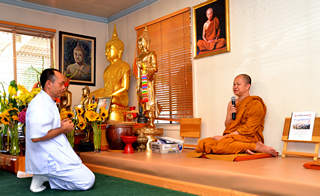
Members of the lay community have revived a tradition practiced in other temples close to ours.
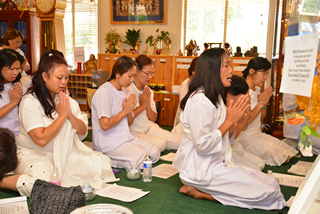
In early June they began, sometimes in groups of only two or three, chanting several parts of the traditional morning chant of the Therevada tradition as the monastic community ate their daily meal.
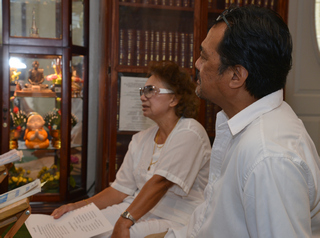
Later in the day, the monks would return to the hall and guide lay members in various evening chantings in both Pali and Thai.
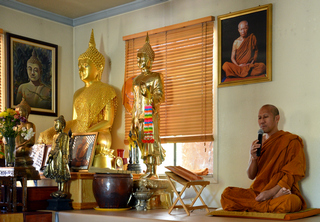
This afternoon chanting is followed by sitting meditation which itself begins with a teaching from the senior monk.

Practicing these chants both brings your mind into a more direct contact with the Buddha's words and also prepares you for meditation.
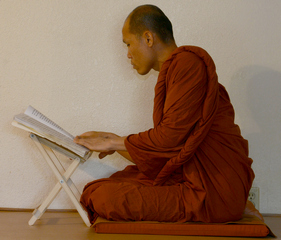
These sessions usually happen on Sundays and are open to anyone who would like a chance to learn and practice these original chants.

The Scent of Virtue
No flower's scent
goes against the wind —
not sandalwood,
jasmine,
tagara.
But the scent of the good
does go against the wind.
The person of integrity
wafts a scent
in every direction.
Sandalwood, tagara,
lotus, & jasmine:
Among these scents,
the scent of virtue
is unsurpassed.
Next to nothing, this scent
— sandalwood, tagara —
while the scent of the virtuous
wafts to the gods,
supreme.
Translated from the Pali by Thanissaro Bhikkhu.
www.dhammatalks.org/suttas/KN/Dhp/Ch04.html
Virtue in the Long Term
Buddhism, like many of the great religions, relies on virtue, or Sila in Pali, to serve as the foundation for developing the insight and compassion needed to achieve the Buddhist goal of enlightenment.
Today, having just completed the Celebration of Songkran, or Thai New Year, that virtue comes to the front in many ways. Families come together from far and wide to recall and strengthen their bonds and thank each other for the support they received throughout the years. Many, both in Thailand and around the world, attend events at Buddhist temples like Wat Sacramento Buddhavanaram to recharge and increase their virtue and become more joyful together as a community.
Part of the Songkran event even includes building and decorating a stupa of sand, created by the community to replace even the small grains of sand each devout Buddhist might have carried away from the temple throughout the year, demonstrating generosity in response to their own unintended taking of a few grains of sand! When you focus on that practice and understand the purpose in returning the sand, imagine how troubling it would be to intentionally come to the temple to steal. Understanding the results of unwholesome Kamma at any level is the beginning of understanding the Buddha’s teaching on Samsara – the cycle of existence – the reality of endless stress and despair for beings.
On April 6th a group of people came to our temple with unvirtuous thoughts in their minds. Their purpose was to deceive the monks and steal from the temple and the community. As much as this might offend any Buddhist, theft and deception have become a way of life for some, even as it was during the Buddha’s time. Our reaction to this must always follow the Lord Buddha’s teaching and, as the Brahma Viharas guide us, we can come to understand all beings have a place, an abiding, within the Viharas, from Mettā to Upekkhā.
While we may be unhappy for a while that someone chose to violate the welcoming and generosity of the monks by stealing from the temple, our budding compassion should take over and spread good will to all beings to prevent our clinging to unwholesome thoughts, speech, and actions.
So let’s carefully consider the benefits of developing our own unbounded compassion and constant virtue for the long-term benefit of all beings, having enjoyed another Songkran with pure open hearts.
The Peg
Āṇi Sutta (SN 20:7)
Staying near Sāvatthī. “Monks, there once was a time when the Dasārahas had a large drum called ‘Summoner.’ Whenever Summoner was split, the Dasārahas inserted another peg in it, until the time came when Summoner’s original wooden body had disappeared and only a conglomeration of pegs remained. [The Commentary notes that the drum originally could be heard for twelve leagues, but in its final condition couldn’t be heard even from behind a curtain.]
“In the same way, in the course of the future there will be monks who won’t listen when discourses that are words of the Tathāgata—deep, deep in their meaning, transcendent, connected with emptiness—are being recited. They won’t lend ear, won’t set their hearts on knowing them, won’t regard these teachings as worth grasping or mastering. But they will listen when discourses that are literary works—the works of poets, elegant in sound, elegant in rhetoric, the work of outsiders, words of disciples—are recited. They will lend ear and set their hearts on knowing them. They will regard these teachings as worth grasping & mastering.
“In this way the disappearance of the discourses that are words of the Tathāgata—deep, deep in their meaning, transcendent, connected with emptiness—will come about.
“Thus you should train yourselves: ‘We will listen when discourses that are words of the Tathāgata—deep, deep in their meaning, transcendent, connected with emptiness—are being recited. We will lend ear, will set our hearts on knowing them, will regard these teachings as worth grasping & mastering.’ That’s how you should train yourselves.”
(Translated from the Pali by Thanissaro Bhikkhu).
dhammatalks.org.
Retrieved from https://www.dhammatalks.org/suttas/SN/SN20_7.html
Strive for the One Protection
The Path – Patacara Vatthu
There are no sons
to give shelter,
no father,
no family
for one seized by the Ender,
no shelter among kin.
Conscious
of this compelling reason,
the wise man, restrained by virtue,
should make the path pure
– right away –
that goes all the way to Unbinding.
— Dhammapada 288-289
Continually Resolute - Itivuttka 111
Controlled in walking,
controlled in standing,
controlled in sitting,
controlled in lying down,
controlled in flexing & extending his limbs
– above, around, & below,
as far as the worlds extend –
observing the arising & passing away
of phenomena,
of aggregates:
a monk who dwells thus ardently,
not restlessly, at peace –
always
mindful,
training in the mastery
of awareness-tranquillity –
is said to be continually
resolute.
translated from the Pali by Thanissaro Bhikkhu.
Access to Insight (BCBS Edition), 30 November 2013,
https://www.accesstoinsight.org/tipitaka/kn/iti/iti.4.100-112.than.html
King Asoka on Dhamma
Dhamma sadhu, kiyam cu dhamme ti?
Apasinave, bahu kayane, daya, dane, sace, socaye.
Dhamma is good, but what constitutes Dhamma?
(It includes) little evil, much good, kindness,
generosity, truthfulness and purity.
From The Edicts of King Asoka
The contents of Asoka's edicts make it clear that all the legends about his wise and humane rule are more than justified and qualify him to be ranked as one of the greatest rulers.
Access to Insight (BCBS Edition), 30 November 2013,
https://www.accesstoinsight.org/lib/authors/dhammika/wheel386.html .
Having a Maha Metta Outlook
When we set our heart to being kind and compassionate to all beings, it is often evaluated by comparing our own effort to others in like situations. This can create an artificial limit that we do not choose to exceed.
How should we like it were stars to burn
With a passion for us we could not return?
If equal affection cannot be,
Let the more loving one be me.
From "The More Loving One" by W.H. Auden
When we hold back, especially concerning those that are not so close as our family and friends, we lose some of the wholesome benefit that developing virtue and practicing loving kindness can create.
If we instead replace that somewhat limited expression of loving kindness with complete, all-encompassing Metta we have certainly entered into a sublime abiding.
Imagine Living with No Money!

Do you know that the Buddha did not allow monks and novices to accept or keep money?
It seems that life in modern times is inconvenient without money in your hand - even for those gone forth into the homeless life prescribed by the Buddha! When we drop money into the alms bowl or slide an envelope full of cash onto the offering cloth are we simply taking the easy approach to supporting monastics while still hoping for the rewards of supporting that unlimited field of merit.
There are many articles on the internet explaining how these rules concerning money are being ignored or worked around by lay supporters and monastic communities. If you practice Dana this way please read Part 1 of the article, "A Life Free from Money" by Dhamminda Bhikkhu. And if you are already aware of the ways some might try to bypass these rules, go ahead and read the rest of the article. Money, as well as the sensual pleasures it can buy, only leads to the downfall of those gone forth. While it is true the lay community is the monastic community's only support, there are specific ways to do that. This article provides clear information on the topic.
Practicing the Dhamma is difficult for all of us. As a lay Buddhist we might do our best to adhere to the five or eight training precepts, either every day or on those special uposatha days when we commit to more complete practice. Our friends in the Sangha have 227 rules in the Vinaya! Each and every rule is important, each and every day, and a few are even grounds for separation from the monastic order. We owe it to them to not perform pious acts that actually threaten their success, and our own.
The true fruit of the Vinaya is found in the pure, restrained hearts of those who practice accordingly! Having this knowledge will allow the laity to properly support the monastic community and yield greater merit for all.
Topics of Conversation
Kathāvatthu Sutta ~ Anguttara Nikaya 10:69
There are some people who always have something to say! Friendly, light hearted conversation can break the ice and let us get to know someone else. But do we ever look back at what we have said and judge the value of our words?
Imagine the Lord Buddha's compassion when he expressed his teaching to an individual or group, laity and monastics alike. His words were insightful, delivered at the right time, and fully in line with the Dhamma.
We may not be able or likely to fully confine our conversations within the ten rules presented in the Kathāvatthu Sutta, as they were meant for monks - those who had gone forth with purpose, and not every day, run-of-the-mill people.
But imagine the power of these ten points of conversation, as if they were a firm, guiding hand, always in the background influencing our words, guiding both the speaker and the listener along the path, replacing the idle chatter that consumes so much time and offers no lasting fruit. Our words when spoken in light of the Dhamma must be accurate and meaningful, spoken with the supreme goal in mind at all times.
There are these ten topics of (proper) conversation. Which ten?
Talk on modesty,
contentment,
seclusion,
non-entanglement,
arousing persistence,
virtue,
concentration,
discernment,
release,
and the knowledge & vision of release.
These are the ten topics of conversation.
If you were to engage repeatedly in these ten topics of conversation, you would outshine even the sun & moon, so mighty, so powerful—to say nothing of the wanderers of other sects.
translated from the Pali by Thanissaro Bhikkhu.
Access to Insight (BCBS Edition), 30 November 2013,
https://www.accesstoinsight.org/tipitaka/an/an10/an10.069.than.html
Birth and Death
These Four Noble Truths — Dukkha, Cause, Cessation, and Path — are the heart of the Dhamma and they are in the heart of every man who cares to see them. From their seeing and understanding comes happiness but by trying to escape them only more misery is born.
The Exalted Buddha has said:
"Whoever sees Dependent Arising, he sees Dhamma;
Whoever sees Dhamma, he sees Dependent Arising."
Anicca vata sankhara
uppada vayadammino
Uppajjitva nirujjhanti
tesam vupasamo sukho.
Conditions truly they are transient
With the nature to arise and cease
Having arisen, then they pass away
Their calming, cessation is happiness.
"The Wheel of Birth and Death", by Bhikkhu Khantipalo.
Access to Insight (BCBS Edition), 30 November 2013,
https://www.accesstoinsight.org/lib/authors/khantipalo/wheel147.html
Discipline as the Foundation of Unbinding
Discipline is for the sake of restraint,
restraint for the sake of freedom from remorse,
freedom from remorse for the sake of joy,
joy for the sake of rapture,
rapture for the sake of tranquillity,
tranquillity for the sake of pleasure,
pleasure for the sake of concentration,
concentration for the sake of knowledge
and vision of things as they are,
knowledge and vision of things as they are
for the sake of disenchantment,
disenchantment for the sake of release,
release for the sake of knowledge and vision of release,
knowledge and vision of release
for the sake of total unbinding without clinging.
Reverence as it should be
We all go about day-to-day behaving in our own way. With our refuge in the Triple Gem, we also try to improve, demonstrating proper respect for the Buddha, Dhamma, and Sangha, as well as all other beings. As all are heir to their kamma, we should not be rude or disrespectful at any time. But we also should take the time to demonstrate respect beyond simple greetings when it is appropriate.
We who are his followers should follow in his footsteps and live with reverence for those three aspects of Enlightenment: Buddha, Dhamma and Sangha.
The gestures used for this are mainly two: respectful salutation with the hands (añjalikamma), and the five-limb prostration (pañc'anga-vandana).
The first of these, which may be remembered as "añjali" as there is no satisfactory English equivalent, is made by bringing the palms of the hands together, and raising them to the region of the heart or higher, according to circumstances. For instance, in the shrine room after kneeling down in front of the Buddha image, one makes añjali before offering flowers, lights and incense. And as the Teacher was the highest in the world and one to go beyond the world, so one respects him by placing one's hand in añjali to the forehead. But while chanting, the hands are held in añjali at heart level. This action and others described here, should be done with mindfulness and therefore gracefully. And one should be careful to see that exaggerated and impetuous movements are avoided. As we remarked before, the Dhamma does not encourage unrestrained expressions of emotion, rather with its aid one endeavors to calm one's heart.
"Lay Buddhist Practice: The Shrine Room, Uposatha Day, Rains Residence",
by Bhikkhu Khantipalo.
Access to Insight (BCBS Edition), 30 November 2013,
https://www.accesstoinsight.org/lib/authors/khantipalo/wheel206.html.
The Simile of the Boat ~ Nava Sutta
He from whom a person learns the Dhamma should be venerated, as the devas venerate Inda, their Lord. He, (a teacher) of great learning, thus venerated, will explain the Dhamma, being well-disposed towards one. Having paid attention and considered it, a wise man, practicing according to Dhamma, becomes learned, intelligent and accomplished by associating himself diligently with such a teacher.
But by following an inferior and foolish teacher who has not gained (fine) understanding of the Dhamma and is envious of others, one will approach death without comprehending the Dhamma and unrelieved of doubt.
If a man going down into a river, swollen and swiftly flowing, is carried away by the current — how can he help others across?
Even so, he who has not comprehended the Dhamma, has not paid attention to the meaning as expounded by the learned, being himself without knowledge and unrelieved of doubt — how can he make others understand?
But if (the man at the river) knows the method and is skilled and wise, by boarding a strong boat equipped with oars and a rudder, he can, with its help, set others across. Even so, he who is experienced and has a well-trained mind, who is learned and dependable, clearly knowing, he can help others to understand who are willing to listen and ready to receive.
Surely, therefore, one should associate with a good man who is wise and learned. By understanding the meaning of what one has learned and practicing accordingly one who has Dhamma-experience attains (supreme) happiness.
"The Discourse Collection: Selected Texts from the Sutta Nipata",
by John D. Ireland.
Access to Insight (BCBS Edition), 30 November 2013, https://www.accesstoinsight.org/lib/authors/ireland/wheel082.html
The Great Questions ~ Mahapañha Sutta
Monks, when a monk becomes entirely dispassionate towards one thing, when his lust for it entirely fades away, when he is entirely liberated from it, when he sees the complete ending of it, then he is one who, after fully comprehending the Goal, makes an end of suffering here and now.
What one thing? "All beings subsist by nutriment." When a monk becomes entirely dispassionate towards this one thing (nutriment), when his lust for it entirely fades away, when he is entirely liberated from it, and when he sees the complete ending of it, then, O monks, he is one who, after fully comprehending the Goal, makes an end of suffering here and now.
Anguttara Nikaya 10.27
Great Causes ~ Maha-Nidana Sutta
Deep is this dependent co-arising, and deep its appearance. It's because of not understanding and not penetrating this Dhamma that this generation is like a tangled skein, a knotted ball of string, like matted rushes and reeds, and does not go beyond transmigration, beyond the planes of deprivation, woe, and bad destinations.
Footprints on the Path
Abiding. Taking note of how we are and what we experience, just as it is, as we follow this Noble Path.
Be aware of each moment. Commit to being aware. Don't just expect awareness to happen.
With awareness, there will be reaction. This is where we are right now. We are connected to our experiences - we have yet to let go. Wrap your reaction according to its proper place.
Everything has a place within the sublime attitudes: immeasurable goodwill, immeasurable compassion, immeasurable appreciation, and immeasurable equanimity. Prepare to do battle with the unwholesome alternatives to this Sublime Abiding.
The Sublime AttitudesWaking Up after Visakha Puja
Having quenched the candle's soft flame, and the incense's fragrant ember becomes cold, dawn breaks on the observer of the Uposatha, and the eight precepts, taken during Vesak. What will we bring with us and what will we leave behind as another day begins? The arising of one thing leads to another, like the sun brings new light and the moon new darkness.
An Analysis of Dependent Co-arising
Paṭiccasamuppāda Vibhaṅga Sutta (SN 12:2)
Staying near Sāvatthī … “Monks, I will describe & analyze dependent co-arising for you. And what is dependent co-arising?
From ignorance as a requisite condition
come fabrications.
From fabrications as a requisite condition
comes consciousness.
From consciousness as a requisite condition
comes name-&-form.
From name-&-form as a requisite condition
come the six sense media.
From the six sense media as a requisite condition
comes contact.
From contact as a requisite condition
comes feeling.
From feeling as a requisite condition
comes craving.
From craving as a requisite condition
comes clinging/sustenance.
From clinging/sustenance as a requisite condition
comes becoming.
From becoming as a requisite condition
comes birth.
From birth as a requisite condition, then aging-&-death, sorrow, lamentation, pain, distress, & despair come into play. Such is the origination of this entire mass of stress & suffering.
Paṭiccasamuppāda Vibhaṅga Sutta (SN 12:2)"
Translated from the Pali by Thanissaro Bhikkhu.
https://www.dhammatalks.org/suttas/SN/SN12_2.html
Venerable Maha Bua
 "Just as if there were a pool of water in a mountain glen — clear, limpid, and unsullied — where a man with good eyes standing on the bank could see shells, gravel, and pebbles, and also shoals of fish swimming about and resting, and it would occur to him, 'This pool of water is clear, limpid, and unsullied.
Here are these shells, gravel, and pebbles, and also these shoals of fish swimming about and resting;' so too, the monk discerns as it actually is, that 'This is stress... This is the origin of stress... This is the stopping of stress... This is the way leading to the stopping of stress... These are mental effluents... This is the origin of mental effluents... This is the stopping of mental effluents... This is the way leading to the stopping of mental effluents.' His heart, thus knowing, thus seeing, is released from the effluent of sensuality, released from the effluent of becoming, released from the effluent of unawareness. With release, there is the knowledge, 'Released.' He discerns that, 'Birth is no more, the holy life is fulfilled, the task done. There is nothing further for this world.'
"Just as if there were a pool of water in a mountain glen — clear, limpid, and unsullied — where a man with good eyes standing on the bank could see shells, gravel, and pebbles, and also shoals of fish swimming about and resting, and it would occur to him, 'This pool of water is clear, limpid, and unsullied.
Here are these shells, gravel, and pebbles, and also these shoals of fish swimming about and resting;' so too, the monk discerns as it actually is, that 'This is stress... This is the origin of stress... This is the stopping of stress... This is the way leading to the stopping of stress... These are mental effluents... This is the origin of mental effluents... This is the stopping of mental effluents... This is the way leading to the stopping of mental effluents.' His heart, thus knowing, thus seeing, is released from the effluent of sensuality, released from the effluent of becoming, released from the effluent of unawareness. With release, there is the knowledge, 'Released.' He discerns that, 'Birth is no more, the holy life is fulfilled, the task done. There is nothing further for this world.'
"This, great king, is a reward of the contemplative life, visible here and now, more excellent than the previous ones and more sublime. And as for another visible reward of the contemplative life, higher and more sublime than this, there is none."
— Samaññaphala Sutta, Digha Nikaya
The Generosity of Alms ~ Beneficial to Monks and Lay People
We have all, at one time or another, stood or kneeled before a monk making our offering of alms with our own motivations and desired outcomes. Maybe we hope for prosperity, long life, or happiness - all worthy goals. As well, many thousands of monks have gone on alms round, standing silently with an open alms bowl, also holding some desire. Seeing the offered food as a simple requisite to further their effort on the Lord Buddha's path is a most noble motivation. We can all, lay and monastic alike, set our hearts on the wholesome benefits of alms giving and see the fruit in this very lifetime. Clearly understanding the dependence each has on the other, the generosity of alms flows in both directions. In the Buddha's utterance of Itivuttaka 107 this relationship is made clear:
This was said by the Blessed One, said by the Arahant, so I have heard: "Monks, brahmans & householders are very helpful to you, as they provide you with the requisites of robes, alms food, lodgings, & medical requisites for the sick. And you, monks, are very helpful to brahmans & householders, as you teach them the Dhamma admirable in the beginning, admirable in the middle, admirable in the end; as you expound the holy life both in letter & meaning, entirely complete, surpassingly pure. In this way the holy life is lived in mutual dependence, for the purpose of crossing over the flood, for making a right end to stress."
Householders & the homeless
in mutual dependence
both reach the true Dhamma:
the unsurpassed safety from bondage.
From householders, the homeless
receive requisites: robes, lodgings,
protection from inclemencies.
While in dependence on those well-gone,
home-loving householders
have conviction in arahants
of noble discernment,
absorbed in jhana.
Having practiced the Dhamma here —
the path leading to good destinations —
delighting in the deva world,
they rejoice,
enjoying sensual pleasures.
Itivuttaka 107, translated from the Pali by Thanissaro Bhikkhu. Access to Insight, 26 September 2019
Making the Dhamma Your Own
- Phra Ajaan Khamdee Pabhaso
As the Buddha said: Form arises in dependence on conditions that are inconstant, stressful, and not-self. So how could form be constant, pleasant, and self? Feelings, perceptions, thought-fabrications, and consciousness arise in dependence on conditions that are inconstant, stressful and not-self. So how could they be constant, pleasant, and self?
All the things that the mind holds to, the Buddha boiled down to physical and mental phenomena, the five aggregates; and to all of these things he applied the three characteristics. All fabricated things are inconstant, he said; all fabricated things are stressful; all things are not-self.
Making the Dhamma Your Own - Phra Ajaan Khamdee Pabhaso, translated from the Pali by Thanissaro Bhikkhu. Access to Insight (BCBS Edition), 2 November 2013
Devine Equanimity
For one who clings, motion exists; but for one who clings not, there is no motion. Where no motion is, there is stillness. Where stillness is, there is no craving. Where no craving is, there is neither coming nor going. Where no coming nor going is, there is neither arising nor passing away. Where neither arising nor passing away is, there is neither this world nor a world beyond, nor a state between. This, verily, is the end of suffering.
Udana 8:3
The Failings of the World
Gain/loss,
status/disgrace,
censure/praise,
pleasure/pain:
these conditions among human beings are
inconstant,
impermanent,
subject to change.
Knowing this, the wise person, mindful,
ponders these changing conditions.
Desirable things
don't charm the mind,
undesirable ones
bring no resistance.
His welcoming & rebelling
are scattered,
gone to their end,
do not exist.
Knowing the dustless, sorrowless state,
he
discerns rightly,
has gone, beyond becoming,
to the Further Shore.
Lokavipatti Sutta: The Failings of the World" (Anguttara Nikaya 8.6), translated from the Pali by Thanissaro Bhikkhu. Access to Insight, 4 July 2010
Mahāpaṭṭhāna
Great Causal Principles

The 24 Modes of Conditionality
This sequence or list is recited by Buddhist monks as part of the merit making for the dead. It contains the various component elements of conditionality that our existence is based upon. Simply hearing this chant might have some wholesome influence on our understanding but not at all as much if we have some knowledge of what it is all about and how it applies to each existence! For instance, after Root Condition, we have Object Condition: All objects [of the six senses] (dhammā) are related to mind-consciousness-element and its associated phenomena by object condition.
Chanting the Mahāpaṭṭhāna
- Hetu paccayo – Root condition.
- Ārammaṇa paccayo – Object condition.
- Adhipati paccayo – Predominance condition.
- Antara paccayo – Contiguity condition.
- Samanantara paccayo – Immediacy condition.
- Sahajāta paccayo – Co-nascence condition.
- Aññamañña paccayo – Mutuality condition.
- Nissaya paccayo – Dependence condition.
- Upanissaya- paccayo – Powerful Dependence condition.
- Purejāta paccayo – Pre-nascence condition.
- Pacchājāta paccayo – Post-nascence condition.
- Āsevana paccayo – Repetition condition.
- Kamam paccayo – Kamma condition.
- Vipāka paccayo – Kamma-result condition.
- Āhara paccayo – Nutriment condition.
- Indriya paccayo – Faculty condition.
- Jhāna paccayo – Jhāna condition.
- Magga paccayo – Path condition.
- Sampayutta paccayo – Association condition.
- Vippayutta paccayo – Dissociation condition.
- Atthi paccayo – Presence condition.
- Natthi paccayo – Absence condition.
- Vigata paccayo – Disappearance condition.
- Avigata paccayo – Non-disappearance condition.
About Being Careful ~ From a Dhammatalk by Ajahn Chah
... Give up evil and develop merit - give up the negative and develop what is positive. Developing merit, remain above merit. Remain above merit and demerit, above good and evil. Keep on practicing with a mind that is giving up, letting go and getting free. It's the same no matter what you are doing: if you do it with a mind of letting go, then it is a cause for realizing Nibbāna. Free of desire, free of defilement, free of craving, then it all merges with the path, meaning Noble Truth, meaning saccadhamma. It is the four Noble Truths, having the wisdom that knows tanhā, which is the source of dukkha. Kāmatanhā, bhavatanhā, vibhavatanhā (sensual desire, desire for becoming, desire not to be): these are the origination, the source. If you go there, if you are wishing for anything or wanting to be anything, you are nourishing dukkha, bringing dukkha into existence, because this is what gives birth to dukkha. These are the causes. If we create the causes of dukkha, then dukkha will come about. The cause is vibhavatanhā: this restless, anxious craving. One becomes a slave to desire and creates all sorts of kamma and wrongdoing because of it, and thus suffering is born. Simply speaking, dukkha is the child of desire. Desire is the parent of dukkha. When there are parents, dukkha can be born. When there are no parents, dukkha cannot come about - there will be no offspring. ...
The entire article is available at: About Being Careful – A Dhammatalk by Ajahn Chah
As a bee without harming the flower, its colour or scent, flies away, collecting only the honey, even so should the sage wander in the village.
Dhammapada 4:6
The Dhammapada - a source of inspiration
We have selected a few meaningful verses from the Dhammapada as a source of inspiration on our home page. For more insight on the occasions when these verses were first spoken by the Lord Buddha, check this site, The Dhammapada: Verses and Stories. Once you are aware of the occasion for each of these concise, meaningful lessons you will surely find greater benefit in studying them daily.
Articles
- Bliss
- Reflections for One Gone Forth
- Heart of a Noble One
- Care for Your Own Heart
- The Poorer, the Happier
All the defilements arise together at the mind.
Focus right at the mind.
Whichever defilement arises first, that's the one to abandon first.
Luang Pu - Phra Ajaan Dune Atulo
Every day we have before us five simple precepts to follow and yet, just those five may seem to us to be very difficult.
On other days, maybe an Uposatha day, we elect to observe eight, at least until the next day's sunrise.
Finally, maybe after committed effort and preparation, we choose to ordain and accept the challenge of 227 precepts, surely enough to ensure perfection.
But even with five precepts as our guide, combined with a commitment to effort, we can develop virtue, concentration, and discernment to overcome the formulations and hindrances that block the path.
Proper and diligent practice is much more fruitful than simply carrying the baggage of 227 precepts - we must know and we must act in order to be liberated.
Thus, bhikkhus, I have taught you the unconditioned and the path leading to the unconditioned. Whatever should be done, bhikkhus, by a compassionate teacher out of compassion for his disicples, desiring their welfare, that I have done for you. These are the feet of trees, bhikkhus, these are empty huts. Meditate, bhikkhus, do not be negligent, lest you regret it later. this is our instruction to you.
Samyutta Nikaya 43.1 (Bhikkhu Bodhi translation) —Anicca (impermanence)
Yataṃ care yataṃ tiṭṭhe, yataṃ acche yataṃ saye
yataṃ samiñjaye bhikkhu, yatamenaṃ pasāraye
uddhaṃ tiriyaṃ apācīnaṃ, yāvatā jagato gati,
samavekkhitā ca dhammānaṃ, khandhānaṃ udayabbayaṃ.
Whether the monk walks or stands or sits or lies,
whether he bends or stretches, above, across, backwards,
whatever his course in the world,
he observes the arising and passing away of the aggregates.
Aṅguttara-nikāya
All is Influenced by the Mind
Even though the mind is intangible, it has influence over the body & all things in the world. It is capable of bringing everything in the world under its control. Still, it isn't so vicious or savage as to lack all sense of good & evil. When a person of good intentions trains the mind to enter correctly into the path of the Buddha's teachings, it will be tractable & quick to learn, developing the wisdom to bring the body, which may be behaving without any principles, back into line. In addition, it can cleanse itself to be bright & clean, free from defilements, able to realize by itself truths that are subtle & profound, bringing dazzling light into this world so dark with blindness.
This is because the true substance of the mind has been, from the very beginning, something bright & clear. But because of the preoccupations that have seeped into it and clouded it, the brightness of the mind has been temporarily darkened, making the world dark as well. If the mind were originally dark, there probably wouldn't be anyone able to cleanse it to the point where it could give rise to the light of discernment at all.
So whether the world is to be dark or bright, whether it is to experience well-being or suffering, depends on the mind of each individual. We as individuals should thus first train our own minds well, and then train the minds of others. The world will then be free from turmoil.
Phra Ajān Thate Desaraṅsī
from "A Chanting Guide", by The Dhammayut Order in the United States of America. Access to Insight, July 25, 2010, https://www.accesstoinsight.org/lib/authors/dhammayut/chanting.html.
Keeping Good Company
From the Mangala Sutta
Asevanā ca bālānam
panditānañ ca sevanā
pūjā ca pūjanīyānam
etam mangalam-uttamam....
With fools no company keeping,
With the wise ever consorting,
To the worthy homage paying:
This, the Highest Blessing....
What is your Daily Puja?
One cannot stand still in Dhamma. Either one makes effort and cultivates oneself, or one slides away from Dhamma to deterioration. Everything suggested here is on the side of Dhamma and leads one to grow in Dhamma, so here is a chance to put into practice the Buddha's words:
Make haste towards the good
and check your mind from evil.
Whoso is slow in making puñña
his mind delights in evil.
If a man should puñña make
let him do it again and again;
he should make a wish for that:
happy is the piling up of puñña.
— Dhp. 116, 118
~ from Lay Buddhist Practice by Bhikkhu Khantipalo
The Healing Power of the Precepts
The Buddha's path consisted not only of mindfulness, concentration, and insight practices, but also of virtue, beginning with the five precepts. In fact, the precepts constitute the first step in the path.
So, we all usually chant along as best we can, maybe aching a bit after sitting too long on the hard floor of the temple. At some point, someone requests the five precepts, "Mayam Bhante, visuṃ visuṃ rakkhanatthāya ti-saraṇena saha pañca sīlāni yācāma ... Venerable Sir, for [our] protection we individually request the Three Refuges and the Five Precepts", that request part of the string and wax seal that help secure our merit for the day. But maybe we have deeper aches that we carried to the temple that day. This rare life, with awareness of what the Buddha taught, isn't always that easy. We know where we should be going but various things get in the way. If after receiving those most basic precepts, their receipt an opening to a virtuous life, we put effort into realizing the goal, the bound up merit we achieve each day can be released into the entire universe for the good of all beings.
Read through The Healing Power of the Precepts by Thanissaro Bhikkhu to gain insight into applying truly virtuous, noble practice to this life.
If you are going to live by any standards, there are none better than these five "standards appealing to the noble ones" which are practical, clear-cut, and humane.
The Path
Of paths, the eightfold is best.
Of truths, the four sayings.
Of qualities, dispassion.
Of two-footed beings,
the one with the eyes
to see.
Dhammapada - 273
Can you try this?
• To avoid all evil, to cultivate good, and to cleanse one's mind — this is the teaching of the Buddhas. [Dhp 183]
• Not despising, not harming, restraint according to the code of monastic discipline, moderation in food, dwelling in solitude, devotion to meditation — this is the teaching of the Buddhas. [Dhp 185]
If each and every day you are able to consider every one of these principles, your strength as a Buddhist warrior and your prosperity will continue to grow!
How fortunate we might be
Every day, and in every moment of each and every day, we are fortunate to have this valuable opportunity. Which opportunity? The rare chance to be aware of and to carefully follow the path and practice that the Buddha discovered and delivered to us.
The times we are in now may appear to be difficult but we should take a moment to consider the cycle of cause and effect that has been in motion throughout time. This lifetime, this human birth, is a treasure we have earned in the past and it should be carefully guarded in the present.
Develop the virtue, commit to the precepts, engage in the practice, and strive for the release the Buddha has made available - if only by our own effort.
We are fortunate for many reasons. First, our birth in this human realm is a rare and auspicious opportunity. Second, we exist in a time when the Buddha and the Four Noble Truths are known. Lastly, it is possible to achieve the goal, the deathless, with right effort and we are free to attempt just that.
Seek a capable teacher, make your practice diligent and right, and reap the benefits of this fortunate opportunity.
An Auspicious Day
Majjhima Nikāya 131 ~ Bhaddekaratta Sutta.
Atītaṃ nānvāgameyya
Nappaṭikaṅkhe anāgataṃ
Yad'atītam-pahīnantaṃ
Appattañca anāgataṃ
He would not range after the past,
Nor wonder about the future.
What is past has been left behind,
The future is as yet unreached.
Paccuppannañca yo dhammaṃ
Tatha tatha vipassati
Asaṃhiraṃ asaṅkuppaṃ
Taṃ viddhā manubrūhaye
Whatever phenomenon is present,
he clearly sees right there, right there.
Unvanquished, unshaken,
That is how he develops the mind.
Ajjeva kiccam-ātappaṃ
Ko jaññā maraṇaṃ suve
Na hi no saṅgarantena
Mahāsenena maccunā
Doing his duty ardently, today,
For — who knows? — tomorrow death may come.
There is no bargaining
With Death & his mighty horde.
Evaṃ vihārim-ātāpiṃ
Aho-rattam-atanditaṃ
Taṃ ve bhaddeka-ratto'ti
Santo ācikkhate munīti.
Whoever lives thus ardently,
relentlessly both day & night,
has truly had an auspicious day:
So says the Peaceful Sage.
— An Auspsicious Day — Access to Insight "Bhaddekaratta Sutta: An Auspicious Day" (MN 131), translated from the Pali by Thanissaro Bhikkhu. Access to Insight (BCBS Edition), 30 November 2013,
Kalyanamitta
And what is meant by admirable friendship? There is the case where a lay person, in whatever town or village he may dwell, spends time with householders or householders' sons, young or old, who are advanced in virtue. He talks with them, engages them in discussions. He emulates consummate conviction in those who are consummate in conviction, consummate virtue in those who are consummate in virtue, consummate generosity in those who are consummate in generosity, and consummate discernment in those who are consummate in discernment. This is called admirable friendship.
— Dighajanu Sutta – Anguttara Nikaya 8.54
The Lotus-like Lay-follower
Thus spoke the Buddha:
A lay-follower (upasaka) who has five qualities is a jewel of a lay-follower, is like a lily, like a lotus. What are these five qualities? He has faith; he is virtuous; he is not superstitious; he believes in action (kamma) and not in luck or omen; he does not seek outside (of the Order) for those worthy of support and does not attend there first.
— Anguttara Nikaya 5.175